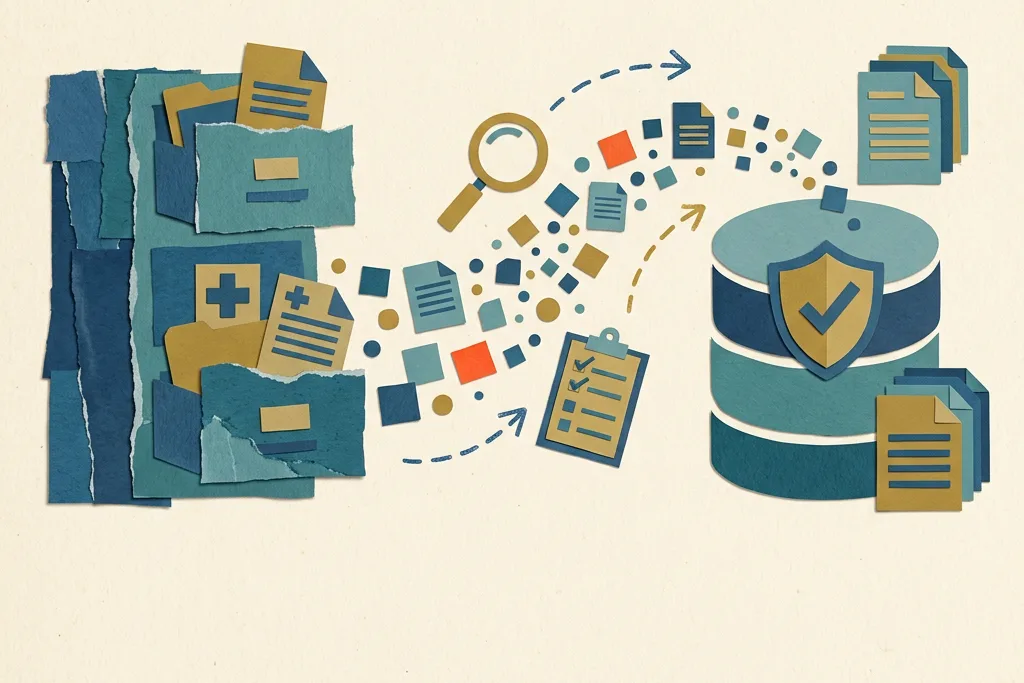
Changing EHR systems is one of the biggest operational projects a healthcare organization can take on. There are months of planning, staff training, new workflows, and 'go-live' dates.
But the biggest technical concern is: "What happens to our patient data?"
Patient records aren't just files that can be copied from one database to another. They contain years of clinical history, scanned documents, medications, billing information, lab results, and provider notes. If that information isn't migrated accurately, the impact can reach far beyond the IT department. Fortunately, modern healthcare data migration has come a long way.
What is EMR data migration?
At its simplest, EHR data migration is the process of transferring patient information from one electronic health record system to another. Things that need to be transferred include:
- Patient demographics
- Clinical documentation
- Diagnoses and medications
- Insurance information
- Billing history
- Lab results
- Scanned documents and attachments
The challenge is that every EMR stores data a little differently. For example, a field called "Primary Insurance" in one system may be structured differently than the new one. Progress notes, attachments, and historical records may all require different handling. Thus, migration isn't just copying information over, but translating it accurately.
One-way migration vs. bidirectional sync
One of the biggest decisions during an EMR transition is how information should move between systems.
One-way migration is what most people think of. Data moves from the old EMR into the new one once, and the old system is eventually retired. This works perfectly well for a lot of clinics.
Sometimes, however, clinics need to operate both systems during a transition. In these situations, information may need to move both directions. For instance, a provider documents in the new system, but that signed note may also need to appear in the legacy EMR. Or patient demographics may be updated in either platform while appointments are being managed across both environments.
This is known as bidirectional synchronization, and while it is significantly more flexible, it is also significantly more complex.
Why bidirectional sync requires careful safeguards
Whenever information can move in two directions, an important question appears: which version is correct?
Imagine that a patient's insurance information changes, or a provider edits a note in one system but not the other. Without safeguards, conflicting or duplicate information can quickly develop.
That is why successful bidirectional integrations rely on rules alongside just moving data. Examples of such rules include:
- Which system is the source of truth?
- Which records should overwrite existing information?
- Which changes require human review?
- How should conflicts be logged?
- What happens if an API call fails?
These questions are just as important as the technology itself.
Whenever information can move in two directions, an important question appears: which version is correct?
API integrations vs. browser-based integrations
Whenever possible, healthcare integrations should communicate directly with the EHR through secure API endpoints. API-based integrations allow systems to exchange structured data directly. They're generally:
- Faster
- More reliable
- Easier to monitor
- Easier to audit
- Less susceptible to user interface changes
Not every EHR, however, offers API access for every workflow — and in those situations, browser-based automation can help bridge the gap.
API vs. browser-based integration
- Application
- Secure API Endpoint
- EMR Database
- Application
- Browser Session
- EMR User Interface
Instead of communicating through an API, browser-based integrations interact with the software the same way a person would — navigating screens, entering information, and completing workflows automatically. It's a practical solution when APIs aren't available.
The key is using it thoughtfully, with monitoring, validation, and clear operational safeguards.
Why audit logs matter
A successful migration isn't just about moving information. It's about knowing exactly what happened. Comprehensive audit logs provide visibility into:
- Which records were migrated
- When they were migrated
- Who initiated the process
- Whether any errors occurred
- Which records required manual review
If questions arise later, those logs become incredibly valuable. They're also an important part of maintaining trust during large system transitions.
Human oversight still matters
Automation has dramatically improved healthcare data migration. It can do things like map fields, transfer documents, validate records, and identify inconsistencies much faster than manual processes.
However, healthcare data is too important to rely entirely on automation. Some records simply require human judgment. For example, historical notes, duplicate patients, unexpected field mappings, or conflicting insurance information.
The strongest migration projects combine automation with clearly defined review checkpoints such that technology handles repetitive work and people handle the exceptions.
How Beam approaches EHR migration
Beam's migration platform was designed around accuracy, visibility, and flexibility. Whenever possible, Beam uses secure API-based integrations to exchange structured data directly with the EHR. When API access isn't available, browser-based integrations can provide an alternative while maintaining monitoring, validation, and auditability.
The platform supports both one-way migrations and bidirectional synchronization depending on the organization's rollout strategy. Patient records, billing information, documentation, and supporting files are mapped carefully between systems, with audit logs tracking activity throughout the migration process. Just as importantly, Beam includes human review checkpoints where they matter most.
A successful migration is one nobody notices
When an EHR migration goes well, patients rarely know it happened. Appointments will continue, providers find the information they need, and billing continues uninterrupted.
That's ultimately the goal. Not simply moving data from one system to another, but helping clinics transition with confidence while protecting the information that matters most.
Planning an EHR transition?
Beam's migration platform combines secure API integrations, browser-based automation where APIs fall short, full audit logs, and human review checkpoints — so your data arrives accurately and nobody notices the switch.
Talk to us about your migration