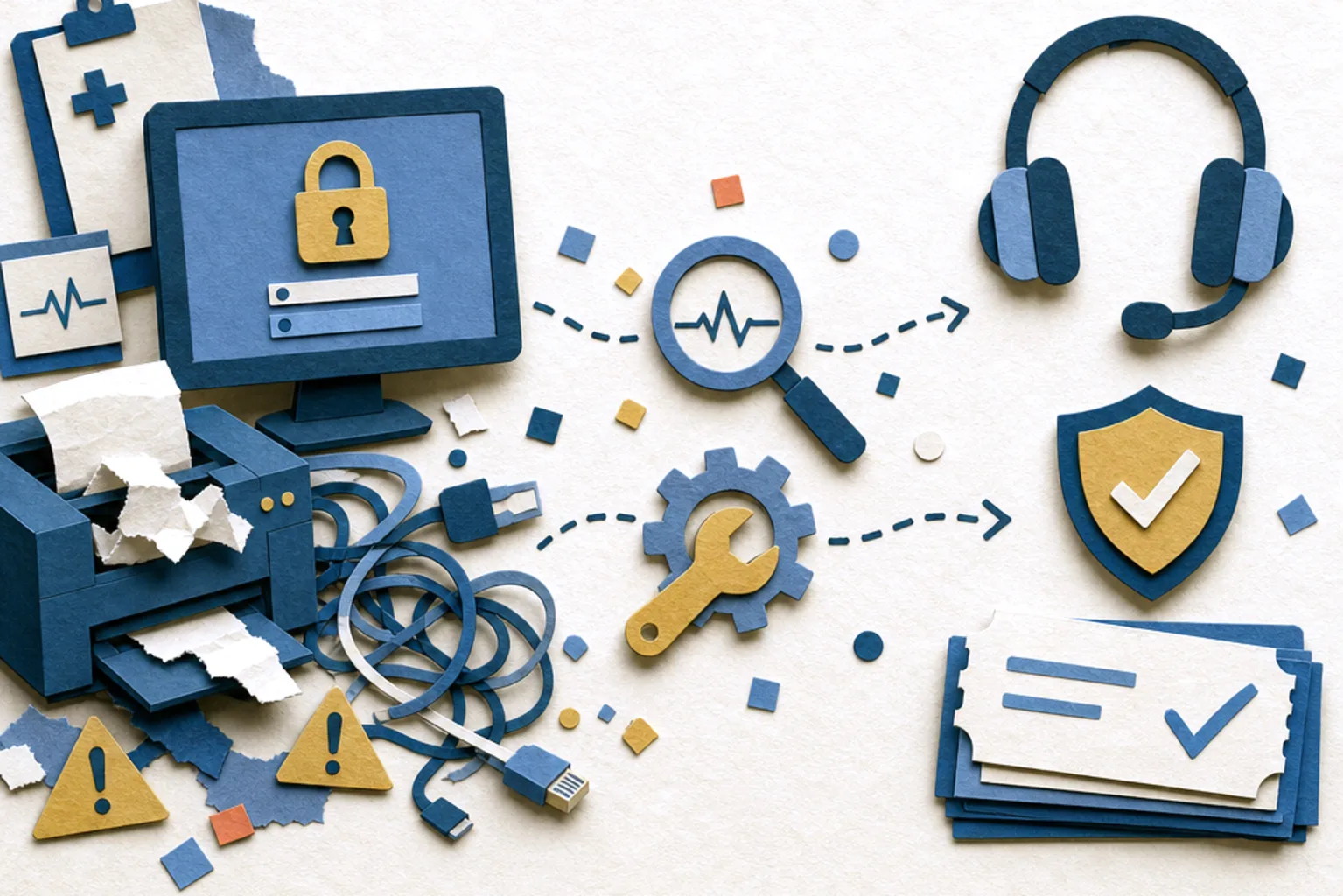
Maybe a password stops working, a printer refuses to cooperate, or someone suddenly can't access the EMR. None of these scenarios sounds like a major technology emergency.
But when you have a waiting room full of patients and six people asking the practice manager what to do, a small IT problem becomes an operations problem pretty quickly. That's why a healthcare IT help desk shouldn't just be there for catastrophic outages. A lot of its value comes from handling the ordinary technology problems that interrupt clinic staff every day.
A healthcare IT help desk shouldn't just be there for catastrophic outages. A lot of its value comes from handling the ordinary problems that interrupt staff every day.
Most clinic IT problems aren't very exciting
Healthcare IT support covers a surprisingly wide range of issues. Some problems are simple: password resets, account lockouts, printer connectivity, or basic access issues. Others involve the EMR, an integration that stopped working, or a system behaving differently than expected. Traditionally, someone at the clinic has to notice the issue, figure out which vendor operates the tech, submit a ticket, and wait.
But a more automated approach starts by asking whether the problem can be identified and resolved before all of that needs to happen.
Where systems expose the appropriate APIs, for example, a support platform can monitor system status, identify certain access or connectivity issues, and potentially trigger predefined fixes. Browser-based integrations can provide another route when direct API access isn't available. The point isn't to automate every IT problem imaginable, but certainly to predict the most common ones.
Monitoring changes the support model
Traditional IT support is reactive:
- Something breaks → Staff notices → Staff reports it → Someone investigates → Problem gets fixed
Monitoring allows that process to start earlier:
- System detects issue → Issue is identified → Known fix attempted → Staff notified if needed
That distinction matters in a clinic because downtime doesn't exist in isolation. An EMR access problem can delay documentation. A printer issue can interrupt registration. A failed connection can stop information from moving between systems. Catching a problem sooner can keep a minor technical issue from turning into a morning of workarounds.
What happens when something breaks?
Example: a staff member can’t access a system.
Can it be resolved automatically?
Not everything should be automated
Importantly, a healthcare IT help desk also needs to know when not to fix something automatically. A forgotten password is very different from an unusual security event. A printer problem is different from an EMR outage affecting the entire practice.
For more complicated issues, the job shifts from automatic resolution to intelligent escalation. That means identifying what went wrong, collecting useful information about the issue, documenting what has already been attempted, and getting it to the right person.
If the problem belongs with the EMR vendor, it goes there. If it requires a clinic administrator, they get involved. If it needs specialized IT or security support, it gets escalated accordingly. Staff shouldn't have to spend half an hour figuring out who owns the problem before anyone starts solving it.
Staff shouldn't have to spend half an hour figuring out who owns the problem before anyone starts solving it.
Where Beam Support fits
Beam Support is designed to provide that first line of support across the clinic's technology environment.
For common, repeatable problems, integrations can allow issues to be monitored and resolved with less staff involvement. For larger problems, Beam can help create a clearer path from detection to escalation rather than leaving clinic employees to coordinate between systems and vendors themselves.
And because support sits alongside the rest of the clinic's operational infrastructure, the bigger opportunity is visibility.
Over time, recurring issues can be tracked rather than treated as isolated tickets. If the same integration repeatedly fails, the same access problem keeps appearing, or one workflow generates an unusual amount of support work, that pattern becomes something the clinic can actually address.
Good IT support should be pretty boring
Nobody wants their healthcare IT help desk to be the most interesting part of their day. Ideally, small problems get handled, bigger problems reach the right person quickly, and staff know where to go when they need help.
Technology should quietly keep the clinic moving, not become another thing the clinic has to manage.
And the practice manager gets to stop being the person everyone calls when the printer decides it has had enough. That’s really the point.
Let small problems stay small.
Beam Support is designed to be the first line of support across your clinic’s technology environment — resolving common issues automatically, escalating bigger ones with context, and turning recurring tickets into patterns you can actually fix.
See Beam Support in action