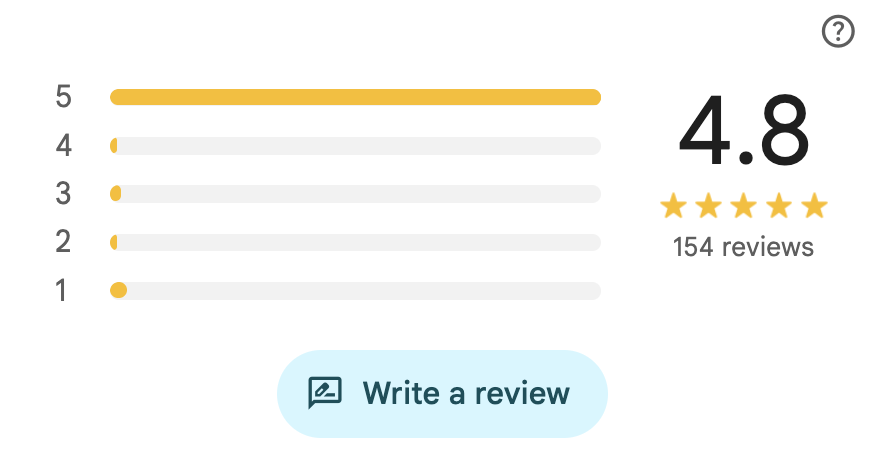
A patient gets referred to your practice, but before they book an appointment, there’s a good chance they will look you up. How patients choose a clinic changes from person to person, but many will look at your star rating, see how many reviews you have, and notice whether the latest one was posted yesterday or eight months ago.
For practices investing in growth, online reviews for doctors and clinics are part of the patient acquisition funnel. But how much are positive reviews actually worth?
A 4.8 isn’t the whole story
Star rating is the obvious number everyone watches, but there are nuances.
Practice A has 4.8 stars, 37 reviews, and a newest review from six months ago. Practice B has 4.6 stars, 600 reviews, with several new reviews this week.
Which profile gives a prospective patient more confidence? There’s no one-size-fits-all answer, but it illustrates why reputation is more complicated than a single rating.
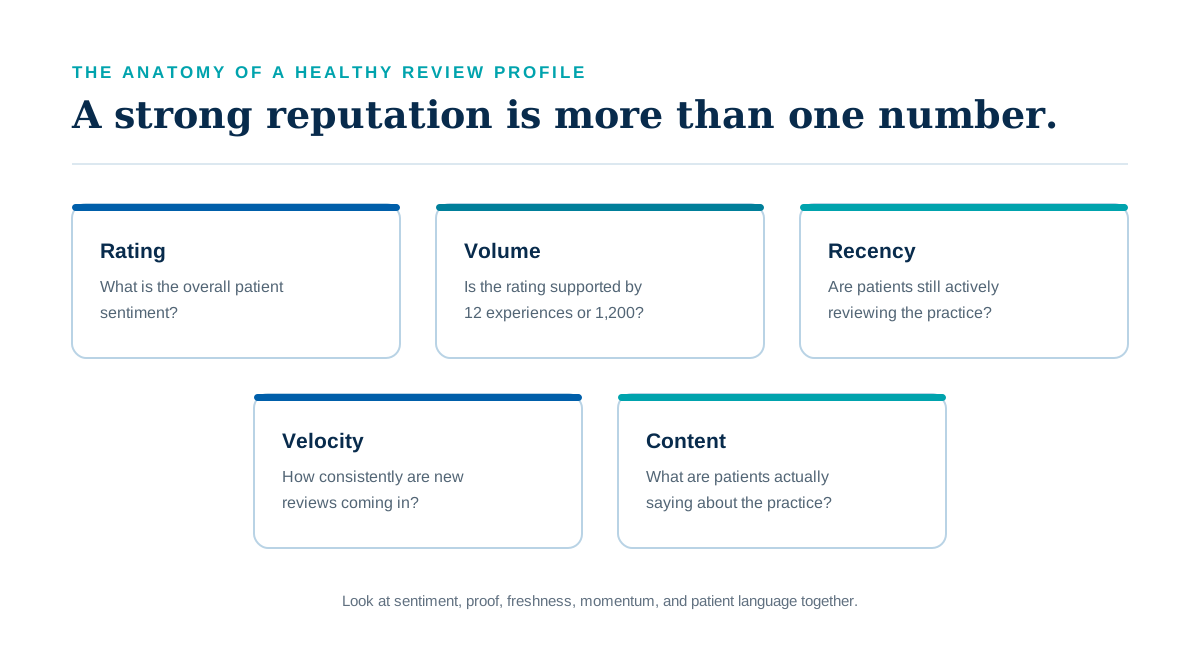
Patients can see rating, volume, recency, and the actual content of reviews. Search engines can also use review signals as part of local search results. When evaluating your reputation strategy, it’s worth looking at the whole picture.
Review velocity might be the metric you’re missing
Review velocity tells you how quickly new reviews are arriving, and it might be more informative than total review count. Consider one recent Beam customer.
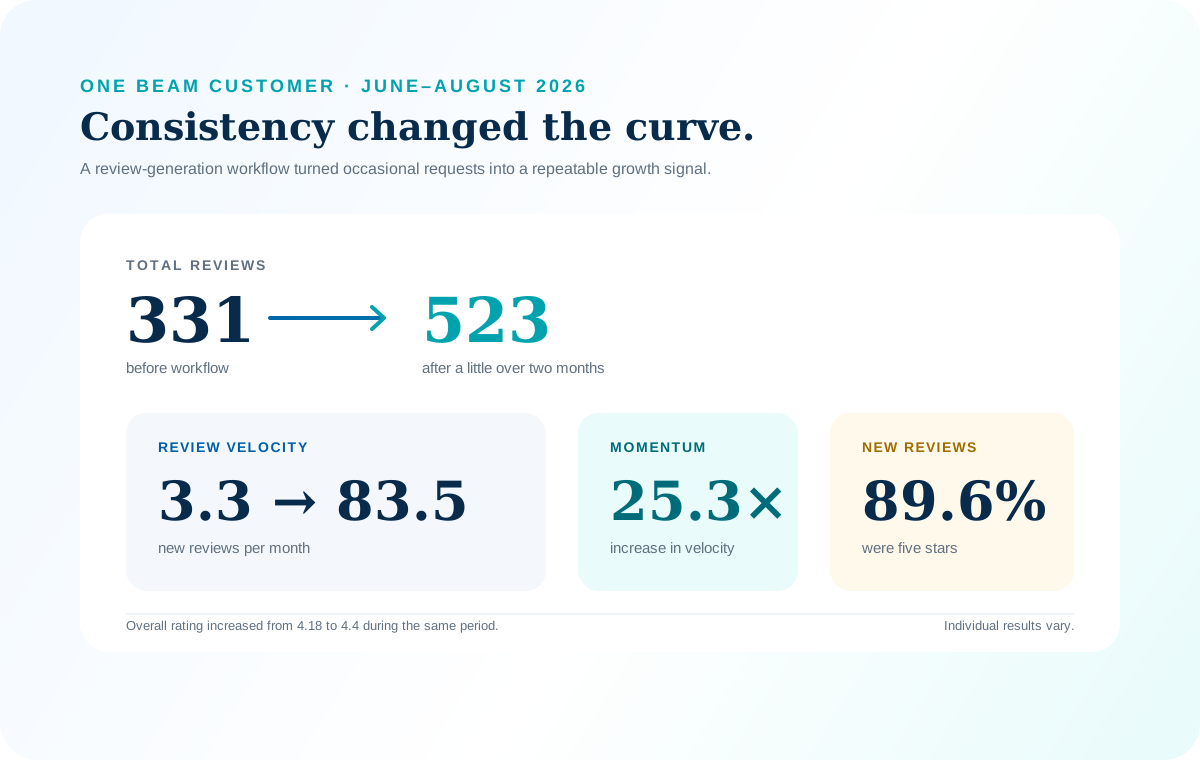
The practice had accumulated 331 reviews over approximately 11 years before launching its new review-generation workflow. In the three months immediately before launch, it averaged about 3.3 new reviews per month.
After launch, that changed dramatically. By August 11, the practice had reached 523 reviews, adding 192 new reviews in a little over two months. Post-launch review velocity reached approximately 83.5 reviews per month, a roughly 25× increase.
And the new reviews weren’t simply adding volume. Of the 192 new reviews, 172 were five stars. That’s 89.6%. The practice’s overall rating increased from 4.18 to 4.4 stars during the same period.
The trick isn’t asking happier patients
A good review-generation system is doing what you do best—providing great care—and then making it easy for patients to provide feedback. The biggest problem is often consistency.
A patient has a great appointment. Someone at checkout remembers to ask for a review. Maybe the patient remembers later. Maybe they find the right profile. Maybe they actually write one. That’s a lot of maybes.
Patient review software can make the request itself a repeatable workflow. After an appropriate interaction, patients can automatically receive a review request via text or AI caller rather than relying on staff to remember every time.
At sufficient volume, that consistency can dramatically change the freshness and depth of a practice’s online reputation.
Reviews are acquisition data, too
What patients write in their reviews is incredibly useful for acquisition.
In the Beam customer example, patients repeatedly praised compassionate and knowledgeable physicians, friendly and professional staff, thorough examinations, and clear explanations. Long-term patients frequently expressed loyalty and a willingness to recommend the practice.
For someone deciding where to book, those comments communicate things a practice’s own marketing copy never could.
But the feedback isn’t always universally positive. Patients also surfaced opportunities around wait times, crowding, accessibility, and follow-up. A review program can become a surprisingly rich stream of patient-experience data: what your practice consistently does well and where the experience may be breaking down.
A bad review isn’t just a reputation problem
Negative feedback is going to happen. Practices should treat reviews as an early-warning system for service issues.
If one patient mentions a long wait, that may be an isolated experience. If ten patients mention it over several weeks, you may have found an operational problem. The same applies to scheduling difficulties, communication, billing questions, accessibility, or follow-up.
This is where healthcare reputation management can move beyond generating reviews to actually improving the patient experience.
Okay, but what’s the ROI?
This is where reputation management gets a little fuzzy. Going from 300 reviews to 500 reviews looks great on a dashboard. But reviews don’t pay the bills. Patients do.
A useful healthcare reputation management ROI calculation needs to connect reputation activity to patient acquisition. Start with the funnel:
Review request → New review → Stronger online presence → Prospective patient visits profile or site → Appointment booked → Patient seen → Revenue
Using this formula, you can get much closer than simply watching your star rating.
Practices can track changes in branded and local search visibility, website traffic from local listings, calls, booking-page visits, appointment conversions, and ultimately completed appointments.
If your review volume jumps and nothing else changes, you have a reputation result. If visibility, calls, bookings, and new-patient volume move with it, you have a growth story.
What could a stronger reputation be worth?
This illustrative calculation does not include downstream visits or patient lifetime value.
Reputation shouldn’t live in its own little dashboard
This is where Beam’s approach to Growth becomes important. Beyond helping generate more reviews, Beam is designed to connect reputation management with the rest of the patient acquisition process.
Reviews and local SEO can help patients discover and evaluate the practice. Website and campaign performance can show what happens next. Scheduling tools and AI-powered patient communication can help turn that interest into an actual appointment.
That makes it possible to think about reviews as one part of a larger acquisition engine rather than an isolated marketing metric. And because patient feedback is being collected continuously, it can also tell the practice where the experience itself needs work.
Don’t collect reviews just to collect reviews
A growing review count and higher rating is great, but neither is the ultimate goal.
The real opportunity is creating a consistent feedback loop: make it easy for patients to share their experiences, understand what they’re telling you, improve the problems that keep appearing, and measure whether a stronger reputation is helping more patients find and choose the practice.
Your reviews are already informing prospective patients. You might as well be listening, too.
Your reputation is part of the patient journey.
Beam connects reputation, local visibility, patient communication, and scheduling so practices can understand what happens between a search and a booked appointment.
Talk with Beam about patient growth